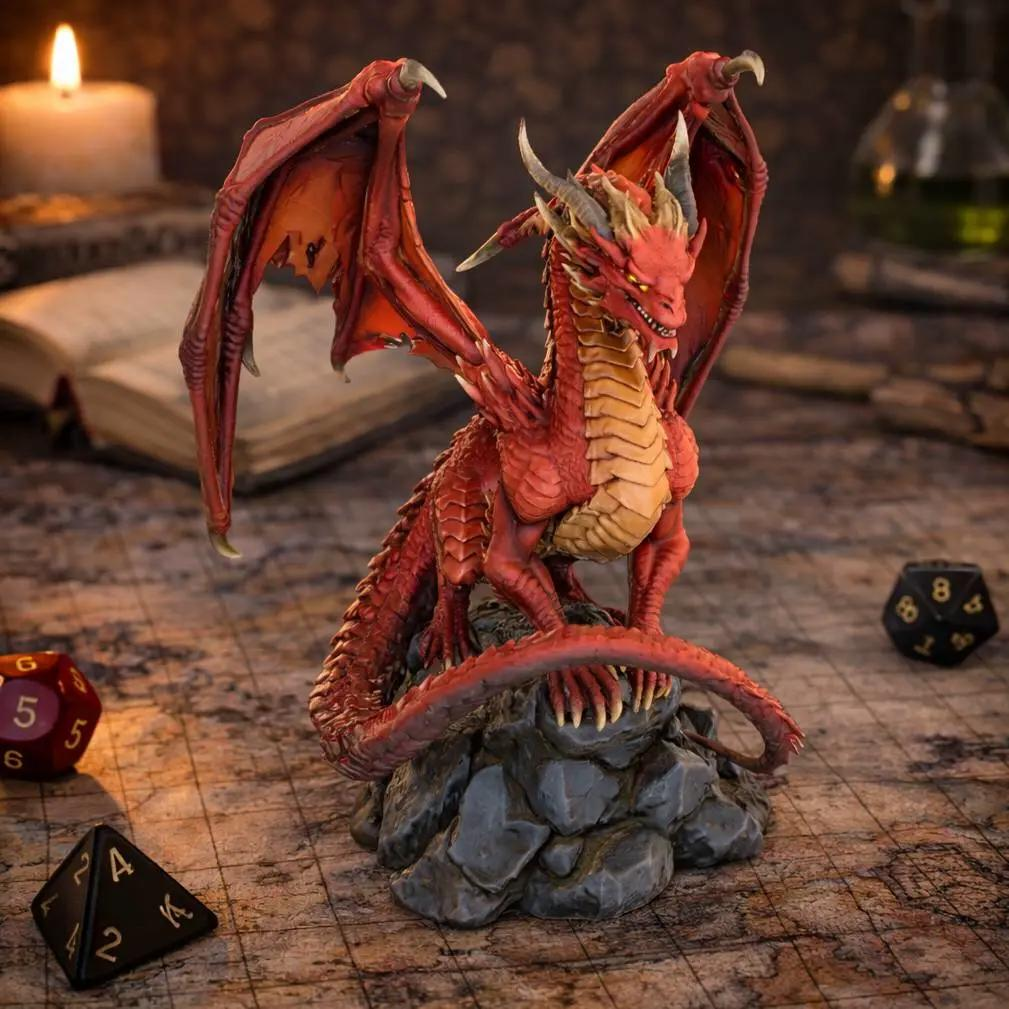

Learn how to read D4 dice, explore common tabletop RPG uses, understand safe handling, and discover practical tips for cleaning and storing four-sided dice.
1. What Is a D4 Die?
A D4 die is a four-sided polyhedral die shaped like a tetrahedron. Unlike the familiar six-sided cube, a D4 has triangular faces and a compact, pointed profile.

D4 dice are common in tabletop role-playing games, including Dungeons & Dragons, where they can determine small damage rolls, healing amounts, or other effects specified by a game's rules.
A standard numbered D4 commonly represents the results 1 through 4. However, the way those results are displayed differs from one design to another. Understanding the numbering layout is important because a D4 may not rest with one obvious number facing upward.
2. How to Read D4 Dice Correctly
Reading a D4 is often the first challenge for new tabletop players. Many traditional D4 dice display numbers along the lower edges of their triangular faces rather than using the same top-face convention as a D6.
On many conventional D4 designs, the number at the bottom of the die, near the surface on which it rests, indicates the result. Other designs may use different layouts, including repeated numbers near vertices or alternative reading indicators.
Always follow the reading convention supplied with your specific die. Do not assume that every four-sided die uses the same system.

A simple way to avoid confusion
Examine the die before your game begins.
Identify how its numbers are positioned on each face or edge.
Check the manufacturer's instructions if the intended result is unclear.
Agree on a consistent interpretation with your group.
When using an unfamiliar die, practice a few test rolls before an important encounter.
If you play in a group with several different dice sets, explaining the reading convention can prevent unnecessary pauses during combat.
3. What Are D4 Dice Used For?
D4 dice are useful whenever a game calls for a random result from one to four. Their actual function depends on the rules of the game.
D4 Dice in Dungeons & Dragons
In D&D, D4 dice are frequently used for damage and other small numerical effects. For example, in D&D 5th Edition, the dagger deals 1d4 piercing damage on a successful hit under the standard weapon rules.

Some spells, class features, items, and other effects may also use a D4, depending on the applicable edition and rules.
A Dungeon Master might additionally use a D4 for a custom four-option event table, such as choosing between four environmental complications. This is a house-rule or scenario-design option, not a universal D&D mechanic.
Other Tabletop Uses
Outside D&D, a D4 may be useful for:
Small damage or healing values in games that specify it.
Four-option random tables.
Custom character abilities and resource systems.
Board-game mechanics involving a small range of outcomes.
Homebrew rules where four equally likely results are appropriate.
Before substituting a D4 for another die, check the game's instructions. Changing the number of possible outcomes changes the probabilities.
4. Understanding D4 Probability
A fair D4 has four equally likely outcomes. Each individual number therefore has a probability of 1/4, or 25%.
For a conventional D4 numbered from 1 to 4:
Rolling a 1: 25%.
Rolling a 2: 25%.
Rolling a 3: 25%.
Rolling a 4: 25%.
Rolling an odd number: 50%.
Rolling a result of 3 or higher: 50%.
The expected result is 2.5. This is the long-run average, not a promise that repeated rolls will alternate between low and high numbers.
A D4 provides a narrower outcome range than a D6 or D8. That makes it appropriate for certain game mechanics, but not automatically better or worse than another die.
5. D4 vs. D6: What's the Difference?
The most obvious difference is shape. A D4 has four triangular faces, while a D6 has six square faces.
| Feature | D4 | D6 |
|---|---|---|
| Number of faces | 4 | 6 |
| Standard numbered outcomes | 1–4 | 1–6 |
| Typical shape | Tetrahedron | Cube |
| Individual outcome probability for a fair die | 25% | About 16.67% |
| Common tabletop role | Small damage rolls and specified effects | General randomization and many board games |
The probability figures assume fair dice with one face for each listed result.
A D6 offers a wider range of possible values, while a D4 offers a smaller one. Game designers choose between them according to the intended mechanics and probability distribution.
6. Choosing D4 Dice for Your Game
A good D4 should be easy to identify, comfortable to handle, and appropriate for your game.
Prioritize clear numbering
Because D4 reading conventions can be unfamiliar, choose a design whose numbers are legible and distinguishable. Contrasting numerals can help, especially during fast-paced sessions.
Consider the shape
The tetrahedral shape is part of what makes a D4 distinctive. If your group finds traditional D4 dice difficult to read or handle, investigate alternative D4 designs and confirm how each one is intended to be read.
Match the rest of your dice set
A D4 can coordinate with a character's color scheme or a complete polyhedral set. Visual consistency can make it easier to keep track of your dice, provided the numbers remain readable.
Review the product specifications
Before purchasing, check the seller's stated material, dimensions, finish, included items, and care instructions. Do not infer these details from product photographs alone.
7. Safe Handling and Use of D4 Dice
Traditional D4 dice have pointed corners and a tetrahedral profile. While ordinary tabletop play is generally straightforward, sensible handling helps reduce discomfort and accidental damage.
Avoid throwing D4 dice toward another person or animal.
Keep small dice away from young children and pets who may swallow them.
Roll on a suitable gaming surface rather than a delicate or easily damaged tabletop.
Collect dice promptly after play to avoid stepping on them.
Store dice where they cannot fall onto the floor or become mixed with unrelated small objects.
If you have young children in your home, consider the manufacturer's age guidance and keep small gaming accessories out of reach. Never assume that a decorative or specialty D4 is suitable as a toy.
A dice tray or soft rolling area can help contain rolls and protect the playing surface. It may also make retrieving pointed dice more convenient.
8. How to Clean and Store D4 Dice
D4 dice can accumulate fingerprints, dust, and residue through regular use. Simple maintenance is usually sufficient.
Wipe away loose dust with a soft, dry cloth.
Use a soft brush to reach decorative grooves or detailed numbering.
Follow the manufacturer's guidance before using water or any cleaning product.
Avoid abrasive pads, harsh solvents, and excessive heat unless explicitly approved for the material and finish.
Allow the die to dry completely before storage.
For storage, consider a divided dice case, a soft pouch, or a compartment that prevents pointed dice from scratching other accessories. If your collection contains painted, metallic-looking, or specialty finishes, separate storage can reduce contact between surfaces.

9. Frequently Asked Questions
How do you read a D4?
Many traditional D4 dice are read using the number at the bottom edge near the playing surface. Other designs differ, so check the manufacturer's reading instructions.
Why does a D4 have triangular faces?
A standard D4 is a tetrahedron, a solid with four triangular faces. Each face represents one of the die's possible outcomes.
What is the probability of rolling a 4 on a D4?
For a fair D4 numbered from 1 to 4, the probability is 1/4, or 25%.
What is a D4 used for in D&D?
A D4 is commonly used for effects such as dagger damage in D&D 5th Edition. Other uses depend on the edition, feature, and specific game rules.
Are D4 dice safe to use?
They can be used as ordinary tabletop gaming accessories, but their pointed corners deserve sensible handling. Keep them away from young children and pets, and use a suitable rolling surface.
Can I clean D4 dice with water?
That depends on the die's material, coating, and finish. Check the manufacturer's instructions before applying water or cleaning products.
How should I store a D4?
A soft pouch or compartmentalized case can keep D4 dice organized and reduce contact with other accessories. Store them away from young children and pets.
10. Final Thoughts
D4 dice may be small, but they play an important role in many tabletop games. Knowing how to read a four-sided die, understanding its probability, and choosing a readable design can make every session run more smoothly.
Whether you are building your first D&D dice set or expanding a collection, prioritize clear numbering, suitable storage, and care instructions that match the die you own.