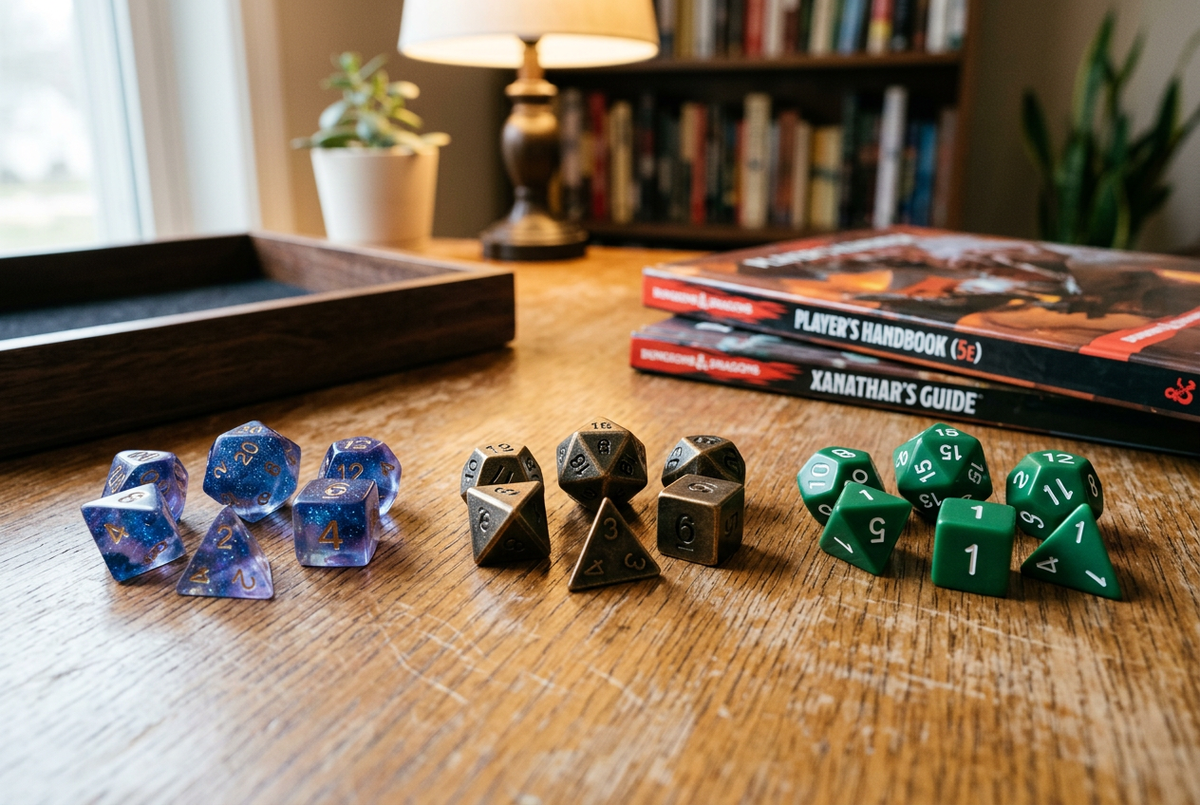

For most new players, one standard seven-piece set is enough to start playing D&D. It gives you the usual die types without asking you to buy a whole collection before your first session.
You may eventually want extra d20s or damage dice. Those additions save time; they don’t unlock rules that a single set can’t handle. If a roll calls for several dice of one type, you can roll the same die repeatedly and add the results.
How Many Dice Do You Need for D&D?
A practical starting set contains seven dice: a d4, d6, d8, d10, percentile d10, d12, and d20. The percentile die is another ten-sided die, usually marked 00 through 90 rather than 0 through 9.

The official D&D Basic Rules explain these die types and how percentile rolls work. A “seven-piece set” is a convenient shopping format, not a rule requiring every player to own seven separate objects.
| Die | What to know |
|---|---|
| d4 | Used when a rule calls for a four-sided die. |
| d6 | The familiar cube; often useful in multiples. |
| d8 | Appears in various damage, healing, and other rolls. |
| d10 | Used for ten-sided rolls and as part of a percentile pair. |
| Percentile d10 | Supplies the tens digit for percentile rolls. |
| d12 | Needed when a weapon, feature, or other rule specifies it. |
| d20 | Used for attack rolls, ability checks, and saving throws. |
Choose Between a Basic Kit and a Faster-Rolling Kit
The Basic Kit: One Complete Set
One set is the sensible first purchase if you’re still learning your character. Check the actual contents of a D&D dice set, since unusual designs and specialty products may contain a different assortment.
Readability matters more than matching your character’s outfit. Look for numbers you can distinguish under ordinary room lighting.
The Convenience Kit: Add Dice You Actually Use
A second d20 makes advantage and disadvantage quicker: roll both together instead of rolling one twice.

Extra damage dice are useful when your character regularly rolls several of the same type. A spell that calls for 8d6 can be resolved with eight dice at once, four dice rolled twice, or one die rolled eight times. The result is calculated the same way; the handling time changes.
Keep separate attack rolls separate. Owning several d20s doesn’t mean unrelated attacks should be combined into one total.
Read Your Character Sheet Before Buying Extras
Look at the dice listed beside the weapons, spells, and features you use most. If several entries call for d8s, extra d8s may help more than a second complete set.
For example, the personalized acrylic D6 is a six-sided format. It can be a meaningful extra for a group, but it won’t replace a d20 or the other shapes in a polyhedral set.
If you already own dice, take inventory first. Our guide to choosing and upgrading a dice collection offers a broader starting point for reviewing what you have.
What Can Wait Until Later?
A physical d100, oversized display dice, and multiple themed sets are optional purchases. You can enjoy them without treating them as beginner essentials.
The same goes for a large storage system. For your first few games, keeping a complete set together and transporting it securely is more important than building a display.

Frequently Asked Questions
Can I play with only one d20?
You can resolve d20 rolls with it, including advantage and disadvantage by rolling twice. You’ll still need access to other die types when the rules call for them, whether borrowed or digital.
Does each player need a separate set?
No. Sharing works if your group is comfortable with it. Having your own set simply reduces passing dice around.
What should I do if my set is missing a die?
Borrow the required type or use a digital roller your group accepts. Don’t substitute a different-sided die without an agreed method, because that changes the possible results.
Buy for Your Next Session, Not Every Possible Session
Start with one complete, readable set. After a few games, you’ll know whether a second d20, extra damage dice, or another full set would make your own turns easier.